HOW TO MEDITATE The practice of meditation is emptying the mind. When the mind is empty, completely empty, it’s perfect meditation. It’s really that simple. This is a brief summary of the meditation techniques taught at the iMeditate classes in New York City. DOWNLOAD FREE MP3 MEDITATION MUSIC You can download the free MP3 meditation music here. There are many, many meditation techniques that you can learn. The best thing to do is try them out and see what works for you. Over time this may change, so you may start with one technique, and then add others as you go along. To hear a talk by Rama on meditating to music click here. There are two techniques described here, both of which use focus. THINGS COMMON TO BOTH TECHNIQUES You need to sit with your back straight. This can be in a chair or on the floor in a cross-legged position. But the important thing is that your back is straight. Don’t lie down as you will become sleepy. You can place your hands in any comfortable position, but for these techniques keep your palms facing upwards. It is good to have a specific place in your home where you meditate. You can setup a small table, perhaps put some flowers or candles or incense there. If you like you can have a pillow or chair to sit on. Meditate in the morning, when the day is before you. After you wake up you may exercise, take a shower or splash some water on your face, and then meditate. Meditate again in the evening, when the day is behind you. Maybe around sunset, or even just before you go to sleep. Again if you can exercise before you meditate that is good, then a shower or washing up, and then meditation. You can chant a mantra before you meditate. Some popular ones are OM and SRING. Chant the mantra, eyes closed, for 4 or 7 or 12 times, with complete focus on the sound. Extend out the mantra as you chant it. These mantras are powerful sounds and will bring light into your mind and prepare you for meditating. While meditating if you find yourself becoming tense or uneasy you may be focusing too hard or simply trying too hard. Ease off a bit, or switch to another meditation technique. Feel free to take a break—get up and walk around a bit, do some stretching, dance about. Whatever it takes to keep frosty. If you are beginning a meditation practice then start with 10–15 minutes per session. After several months extend that to 20–30 minutes, and then after a year or two to 45–60 minutes. Try to be consistent. It's better to meditate for 15 minutes each day than an hour every few days. After your session it is good to bow and offer your meditation to eternity. You have sat and quieted your mind and felt something deeper, now let the meditation go. Don’t judge a meditation session, especially while you are meditating. You may experience endless thoughts or feelings, but inwardly in other dimensions your higher self is experiencing light. So you may only feel that light filter down into your everyday-mind after the meditation. TECHNIQUE 1: EXTERNAL FOCUS ON A YANTRA This technique involves an external focus on a yantra. This is done to strengthen the mind, it is like push-ups for your mind. It takes a strong mind (which we all have) to learn to meditate.
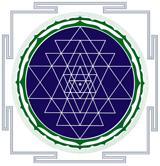
A yantra is connected by its structure and design to higher dimensions of mind. By focusing on it you will unlock these dimensions and the light from them will flow into your mind. Place the yantra a few feet away from you so that you can see it clearly. It is good to have it at about eye level, or a bit below, so there is no strain on your neck. You can get a plastic stand for them at Staples. To meditate on a yantra sit facing the yantra with your eyes opened. Then simply put a one-pointed focus on the dot in the center of the yantra (called the bindu). As thoughts come and go simply ignore them. You may see the yantra glow, or the lines move, or other visual changes. This means that you are meditating, and that your mind is moving into non-physical dimensions. You may see no visual changes at all, and this also means you are meditating. Just keep focusing on the dot at the center. Focus as intensively as you can. You are strengthening your mind, developing one-pointed focus. TECHNIQUE 2: MUSIC & INTERNAL FOCUS ON A CHAKRA This technique involves an internal focus on a chakra while listening to electronic music that is designed specifically for meditation. CHAKRAS The chakras are energy centers located in our energetic subtle body. The subtle body is a body of light and energy about the same shape and size as the physical body. Some people see auras around other people. The aura is the surface of the subtle body. The subtle body is composed of fibers or filaments of light. These fibers join together in many places in the subtle body, and these places are known as chakras.
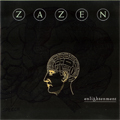
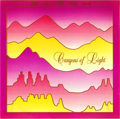
There is one more chakra that is not connected to the other six, and that is the sahasrara chakra at the top of the head (gold). This is the crown chakra, or thousand-petalled lotus. When the kundalini makes the leap from the third eye to the crown chakra the meditator enters into samadhi. In this technique the third (navel), fourth (heart), and sixth (third eye) chakras as used as focus points for meditation. The energy of the other chakras will automatically be drawn into these meditations. There is no need, in the beginning, the focus on the other chakras. The chakras are doorways to other parts of our minds, to other dimensions of awareness. They are very high and pure and powerful dimensions. And so as we focus there and quiet our minds we begin to experience them, and also the light and power of these dimensions will flow into our minds and bodies. Good thing! MUSIC The two music CDs handed out in class are for meditating to music. You can also download MP3s of these two CDs here. Both CDs are by the musical group Zazen. The Enlightenment CD (black design) is for morning meditation and the Canyons of Light (sunset design) is for evening meditation. Why meditate to music? With 6–7 billion people on the planet there is substantial auric pollution around us all the time. This auric pollution is all of the thoughts, desires, attachments, feelings, and beliefs of all of the people across the planet. Each person is like a radio transmitter, and their mind streams out waves of consciousness that carry their thoughts and desires.
And so Rama composed this music specifically for meditation. The music has been empowered to provide an auric shield that will help block out the awareness waves that blanket our planet. It will simply make it easier for you to meditate. Each CD has 15 songs, and they are composed around these three chakras:
In the morning use the Enlightenment CD, and in the evening use the Canyons of Light CD. At first you may feel that the chakras are difficult to locate with your mind, but just focus on the physical location. Your mind will automatically locate the chakra in your subtle body. As you meditate on the chakras keep your eyes closed. Sometimes it is easier not to close your eyes all the way, but just to close them almost all the way, but still allow a little bit of light to enter. This will help keep you more alert. STOPPING THOUGHT It can be difficult to stop thought, and in the beginning it is best not to fight with your thoughts. At times you will get caught up in a train of thought. When you realize that just hop off of the train and return your focus to the yantra or the chakra. As you practice you will experience less thought more often. Practice works. |
||||||||





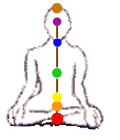 There are six principal chakras located along the shushumna, a subtle nerve channel that runs along the spine.